Working context
Materials are experienced through touch, sound, temperature, reflection, maintenance, and ageing—not only colour. A useful selection process connects these qualities to the room's traffic, moisture, sunlight, cleaning, safety, and expected lifespan. The most expensive or visually dramatic option is not automatically the most appropriate.
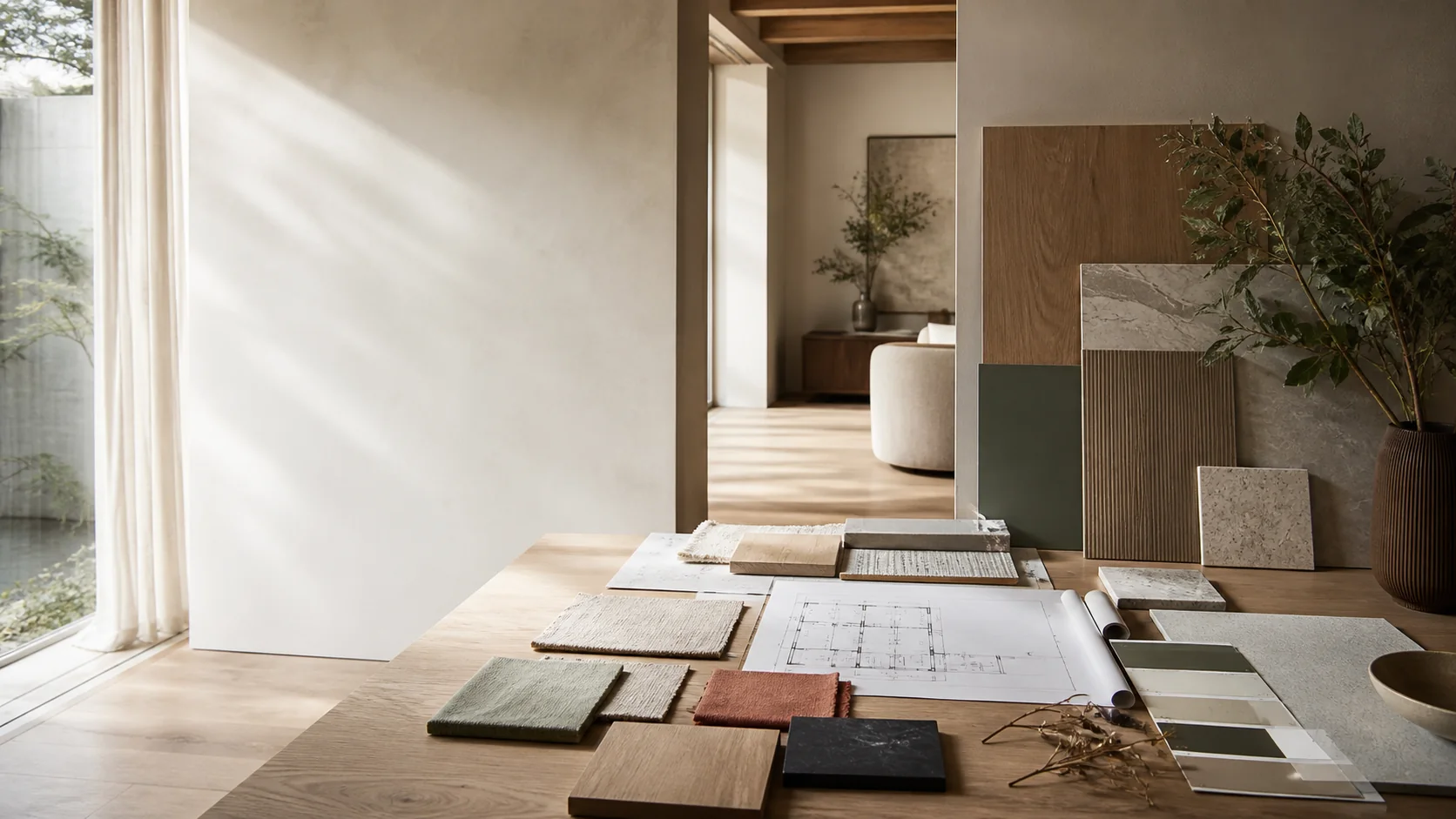
Samples should be treated as evidence, not promises. View them together, in the intended room, under changing light. Ask how joins, edges, transitions, fixings, replacement, and repair will work. The material story becomes coherent when a restrained set of choices performs well and repeats with purpose.
SECTION 01Translate atmosphere into physical qualities
Words such as warm, quiet, crisp, grounded, or light should lead to measurable properties. Warmth may involve colour, texture, acoustic softness, or surface temperature. Quiet may require fewer reflective finishes and better sound absorption. Define the intended feeling, then identify which material qualities can create it without compromising cleaning, access, safety, or everyday comfort.
SECTION 02Compare the whole ownership cycle
Record purchase and installation requirements together with maintenance, likely wear, repairability, replacement, and disposal. Ask which products or skills will be needed later and whether components can be repaired independently. For wet, high-traffic, food, children's, or accessibility-sensitive areas, verify the relevant performance information and installation guidance rather than relying on visual similarity.
SECTION 03Control variety through a clear hierarchy
Choose a calm base, a smaller group of supporting materials, and a limited accent. Repeat tones, grains, edge details, or hardware where that creates connection. Contrast should help define zones, scale, or emphasis—not compete everywhere. Make a final sample board that includes every adjacent finish, because materials that work individually can conflict when their undertones and sheen are compared directly.
Carry these checks into the decision.
- Define use, traffic, moisture, sunlight, and cleaning conditions.
- View samples together in the actual room and planned lighting.
- Compare installation, maintenance, repair, and replacement requirements.
- Verify product guidance for safety- or moisture-sensitive locations.
- Limit the palette and document where each material repeats.
Keep evidence, context, and limitations together.
This guide is designed to organise a practical review. Confirm important facts with the responsible venue, provider, manufacturer, public authority, or qualified professional. Record the date and source of information that can change, and distinguish verified requirements from preferences or estimates.
Good planning does not remove uncertainty. It makes assumptions visible, gives open questions an owner, and creates a clearer point for responsible decisions.
Questions to test
Useful answers begin with a precise question.
How large should a sample be?
Large enough to reveal colour variation, grain, texture, sheen, and the effect of surrounding finishes. Small chips are useful for screening, but final decisions benefit from larger samples or trial areas.
Is a natural material always more durable?
No. Durability depends on the material, grade, finish, installation, environment, use, and maintenance. Compare verified performance for the actual condition.
How should trends influence a material palette?
Use them only when they support the room's purpose and the owner's genuine preference. Long-lived fixed materials usually benefit from broader coherence rather than short-lived novelty.
Bring the whole decision back into view.
A successful material palette feels considered because every surface has a role. Beauty, maintenance, ageing, and repair belong in the same decision—not in separate conversations after installation.
This page provides general educational information. It does not replace technical, legal, medical, financial, safety, or other professional advice for a particular situation.